Dr. Gymbro
←

#randomised trial

1 article
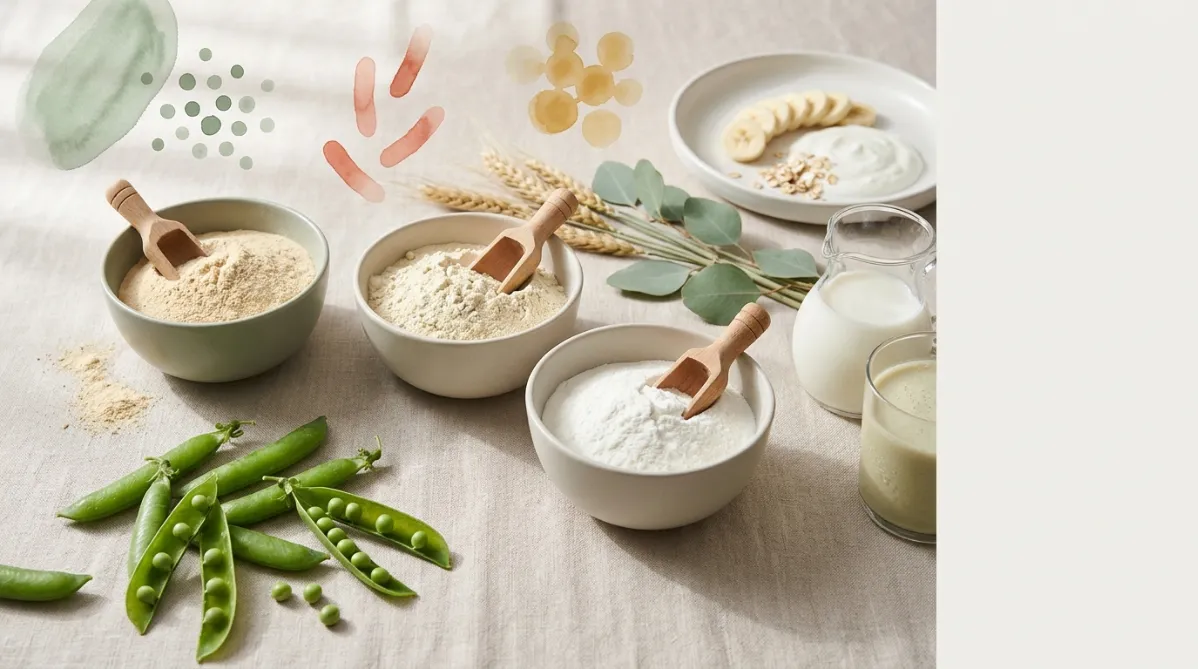
A wide, softly lit editorial flat-lay on a pale oat-colored linen surface, shot from slightly above. Three matte ceramic bowls sit in a loose diagonal across the frame. One holds fine, creamy beige pea protein concentrate, another holds paler, powdery pea protein isolate, and the third holds bright white whey protein isolate. Each bowl has a small wooden scoop resting beside it, with a few fine dustings of powder on the linen. Fresh green pea pods, split open to show round peas, spill naturally in the left foreground. A small glass pitcher of milk sits near the right edge, next to a half-full glass of a smooth, pale green-beige shake with condensation on the surface.

Behind the bowls, a few sprigs of dried wheat and soft eucalyptus leaves add organic texture. In the upper right, a shallow white ceramic plate holds a small arrangement of gut-friendly foods: sliced banana, a spoonful of plain yogurt, and a few oats. Delicate watercolor-style abstract shapes in sage green, warm coral, and soft mustard float subtly in the background. They suggest microscopic organisms, like loose dots, rods, and clustered circles, but stay painterly and minimal, not scientific or futuristic.

Natural window light enters from the left, casting long, gentle shadows and a warm, airy glow. The palette is muted and modern: sage green, cream, warm beige, blush, and touches of terracotta. The composition leaves generous clean negative space on the right third for a headline overlay. The depth of field is shallow, with the nearest pea pods and the front bowl crisp and the background softly blurred. The style is high-end wellness magazine photography with a subtle tactile, handmade feel, calm, fresh, and contemporary, in a 16:9 landscape format.
science research

Quelle poudre de protéines remodelle votre intestin ? Le pois l’a fait en 4 semaines

BY DR. GYMBRO ·

Un essai suédois de quatre semaines a comparé le concentré de protéine de pois, l’isolat de protéine de pois et l’isolat de protéine de lactosérum, en mesurant leur impact sur le microbiote intestinal. Les deux formes de protéine de pois ont modifié de façon significative la diversité du microbiote, chacune favorisant des espèces différentes. Le concentré a stimulé *Bifidobacterium longum* et *Anaerobutyricum hallii*, tandis que l’isolat a favorisé *Lactobacillus crispatus* et *Limosilactobacillus frumenti*. Les chercheurs soulignent toutefois que l’interprétation fonctionnelle de ces changements demeure incertaine.

This page is available in